Reconciliation

Our vision of an inclusive community depends on us doing our part in addressing the injustice and harm done to Aboriginal and Torres Strait Islander people and building a community where everyone has the right to flourish.

Our vision of an inclusive community means supporting self-determination and social and emotional wellbeing for First Nations people, and acting as trustworthy partners in the work we do.

Our Reconciliation Action Plan (RAP) is our public commitment to meaningful action towards reconciliation while documenting our own reconciliation journey.

Our RAP is guided by Aboriginal and Torres Strait Islander people – colleagues, community partners, mentors – and shapes how we serve the people we support and behave with each other.

To make sure our RAP is alive within the whole of our organisation and front of mind every day, we asked First Nations staff and senior management to come together and set goals that feel like a stretch for us – that feel courageous.

Commitments Wellways binds itself to

We will build sustained, trusting and meaningful relationships with First Nations communities and organisations to ensure our services are truly inclusive for all and to strengthen our communities.

We will:

Share our power and resources and be publicly accountable when working with First Nations communities and organisations. We will make decisions with and not on behalf of our First Nations partners.

Measure our success through the feedback of our First Nations partners.

Create a First Nations staff working group that reviews the way Wellways works with First Nations communities and holds all staff accountable for culturally safe and competent practices. This group will have direct contact with the CEO to reflect on decisions and learnings.

We respect and honour First Nations culture and experiences and are grateful to leaders and communities who have paved the way for our work today.

We will:

Act as public advocates and ‘action takers’ for racial justice and First Nations justice, using our platforms to share the expertise of First Nations leaders.

Learn more by undertaking culturally competent and anti-racist training and practice and ensure every staff member has a learning plan that covers this.

Set individual plans to learn the history and stories of First Nations communities and of the land we work and live on, so we can meaningfully acknowledge the country we are on.

Make sure our senior managers engage and listen to Elders in the community in regards to the direction of our work, to ensure it aligns with community needs and wishes.

We will create opportunities for First Nations people to work and thrive at Wellways because First Nations peoples skills, knowledge, experience and thinking is vital to achieving an inclusive society for all.

We will:

Set explicit employment targets for First Nations staff, and ensure succession plans, retention strategies and supports for First Nations staff members are in place.

Create more First Nations identified positions, including management positions.

Codesign and consult First Nations communities and organisations before applying or planning for work that clearly impacts First Nations people.

Flag-Clarity-Medical-Aboriginal
Flag-Clarity-Medical-Torres-Strait-Islander

Our Reconciliation Promises were co-produced by Aboriginal and Torres Strait Islander staff and senior managers.

Community strengthening community

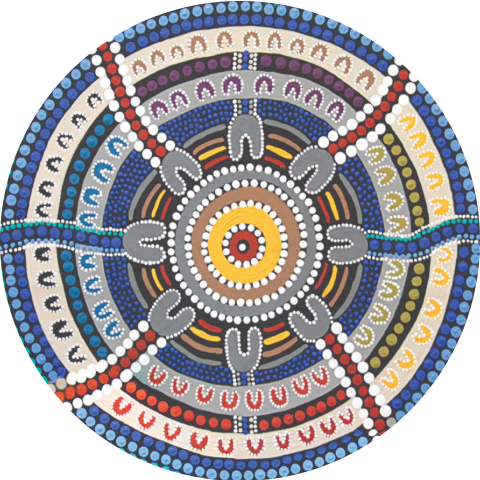
Award-winning artist Heather Kamarra Shearer was commissioned to create an artwork interpreting how the programs and services of Wellways can provide support, advice and ongoing partnerships with Aboriginal and Torres Strait Islander people living with mental health issues or disability and their families, friends and carers.

– I think art, no matter what genre, whether it’s theater, whether it’s poetry, whether it’s writing, whether it’s dance, is our creative juice, is our, you know, is connected with our spirit, is connected with our soul. I’m a member of the stolen generation. I was taken from my mother when I was 10 days old. My mother passed away three months before I found her. And it’s still a trauma that will live with me, be with me to the last day. But going home was where I met my extended family and a lot of my mother’s cousins, my aunties are artists. They would share their artwork with me which helped me to understand where I belonged and where I fitted in within the culture. I started painting in 1991, which was a way to share with my family where I’d been for 29 years. to share with my family where I’d been for 29 years. I can’t speak my language and art has become now my voice. Art was never really something that I saw as a career. It was rather an avenue for me to be able to look at my issues and get them out of my head and onto a canvas. So it became a tangible way for me to deal with a lot of the situations, the trauma that I’ve been through. I’ve done a lot of commission work for various organizations to do with various social justice issues around health. I do a lot of art healing workshops with other groups. I’ve done them with stolen generations, people with children in remand centers, where they’ve been in and out of foster homes over the years to help them to find their place and find their balance. And it’s not about making a pretty picture to show all the happy things, it’s about dealing with the hard issues. I was commissioned by Wellways to produce a painting to interpret the services that they were wanting to offer to Aboriginal and Torres Strait Islander people. So, it starts with the campfire. Then this represents the gray coming in to represent depression and issues around mental health. to represent depression and issues around mental health. With the artwork that I do, it’s based on Western desert art from central Australia. So the imagery of the campfire, the concentric circles in the center is serious. It’s Tjukurrparis, our law. And it can be used to interpret so many different things. And this one, it’s the campfire. Pathways out show the journeys that people go until they’re in their own place. And I’ve used colors of grays to show where no matter where we are, to show where no matter where we are, there are triggers that come up in our lives that might take us a steps back. And sometimes you might take us a few steps back but you can always go forward. The triangles represent the mind, the conflict and going from ping pinging inside. And so, with the support of the colors that are coming in for the services, they’ve now getting a clear pathway on how to go. And then as they go through their journey, until they’re in a place where they’re.

– In a good place.

– In a good place. The artwork I hope will provide another avenue for people to look at how they might be able to express themselves in where they’re at in their journey. Because art is a voice of the people. It’s an opportunity to be able to get what’s inside of you out.

When Heather was first commissioned to do the artwork for Wellways, she was inspired by the organisation and the way in which we work, as our emphasis on community and cohesion shares similarities with the ethos of the Aboriginal family.

“It is about providing support. It’s not just about delivering the service to an individual. It is looking at holistically how the community—how the family, the extended family—can all be part of this. That is very much a way within the Aboriginal family … that’s what I liked about Wellways. The areas of the service delivery, whether it was working individually, whether it was providing to the family, it all interconnected.”